Thursday, 19 February 2015

twenty fifteen

A little quantification never killed anyone.

So, 2014 ended and 2015 has begun. I have already made one good resolution of getting up early morning and saying 'YES' to doing things on weekends. Weirdly enough, I am always torn between "doing everything because each day counts" versus "Not doing anything to avoid wasting time/energy."

Two months into 2015 and I have already-

1. Visited NDTV's studio for the 'Big Fight'
2. Attended all three days of tarang (LSR- awkward because I did this for the first time in 3 years). Saw Raghu Dixit Project live, Some random DJs live (who I hear are famous)
3. Heritage Walk (Ghalib's Haveli and Chandni Chowk, Old Delhi... This did not happen because I overslept but I was there in spirit.)
4. Attended my first Protest on valentine's day 2015 (this one would require a post in itself)
5. Attended my first Poetry Slam Session (Mildly Offensive Content)
6. Doing an extra course on the Perennial Philosophy of Hinduism
7. Cooked 2 different types of Pasta for two whole weeks (personal challenges.... )
8. Drove everyday at 8 am from ashram till south delhi (4 flyovers)
9. Played Mark Antony for an English Play audition
10. Visited the world war 1 museum at Indira Gandhi Museum, Delhi
11. Ate a Burrito (first time, always had enchiladas till now...)

I will definitely keep updating this list. Because I over heard someone say "It's your life and it's ending one day at a time." Never knew eavesdropping could spring me into action, haha.

World War 1, Museum Visit, New Delhi, January 2015


The Raghu Dixit Project, Live, First Row (After a lot of pushing) - Jan 2015


Protest, 14 February, 2015
Venue- Let's keep that a mystery


Wednesday, 3 December 2014

An analysis of the movie- 'The Oxford Murders'

Submitted previously as a Classical Political Philosophy assignment (Sameera S. Rao, 2014).

An Analysis of the movie ‘The Oxford Murders’
PART I – Mathematical ideas and themes prevalent throughout the movie

The beauty of mathematics is not limited to number series or formulas applicable only to the academic discipline. This is because mathematical patterns can also be found in the real world. For instance, the ‘perfect symmetrical face[1]’ is said to follow the ‘the golden ratio’ (mathematically, two quantities are in the golden ratio if their ratio is the same as the ratio of their sum to the larger of the two quantities.) Pinecones naturally occur in the Fibonacci number series (they are of the following pattern: 1, 1, 2, 3, 5, 8, 13, 21 - infinity. Each subsequent number is the sum of the previous two). In academia, one can find proponents of ‘logic’, who state that mathematical patterns and sequences are present in nature, humans etc. On the other hand, others argue that this is simply exaggeration. Those who believe in mathematical purity, state that seemingly abstract biological processes occur in a certain mathematical pattern (for instance, the DNA) and it is the task of mathematicians or logicians to identify these patterns.
One of the most striking dialogues that caught my attention in ‘The Oxford Murders’ is the staunch belief held by the graduate student (Martin) in the ‘absolute truth’ – where absolute truth extends into the world. Martin states “I believe in 3.141592 (irrational number Pi[2]) the nature of reality ascribed in mathematical numbers. Numbers are pre-existing patterns in reality.” The Oxford Professor quickly retorts by asking- “Why can’t a single person then, predict a hurricane? We like order, logic we are not in the hands of destiny- this has nothing to do with truth, only with fear.” The fast-pacing dialogues in the movie explore themes of freedom, chaos theory, uncertainty principle, memory, mathematical symbols etc.
The movie shows the dysfunctional relationship between Beth (daughter) and Mrs. Eagleton (mother). Beth is an aspiring violinist, who bitterly despises her circumstances because she has the sole responsibility of taking care of her ailing mother. Beth is also attracted to Martin and wonders what it must be to be like him- to travel, study and explore outside his comfort zone (he is from the United States studying in England). 

PART II – Interpretations of the film through various schools of thought
(i)                         Psychoanalytical Perspective: It is clear from the beginning of the movie that Martin is the main narrator of events and the audience will experience reality- through all five senses as Martin sees it. Martin’s subjectivity includes an almost unidirectional belief in mathematical purity. Martin’s background as a mathematics graduate student studying at Oxford makes him value the ‘gifts’ of mathematics. He shows us that he has an ability of solving a murder mystery by unlocking mathematical symbols. This is Martin’s Achilles heel. He ignores the timing of discovering Mrs. Eagleton’s body with the Oxford Professor (thinking of it as a coincidence) and gets manipulated into thinking in the existence of a mathematical serial murderer. Psychoanalysts believe that motivations of individuals are embedded in their subconscious mind. Therefore, the convictions of Martin’s mind (about mathematics being the absolute truth) would lead him to believe the Professor- and he subconsciously tries to “win the approval” of his revered professor who had earlier ridiculed him and refused to be his supervisor.

(ii)                     Feminist Perspective – A gendered perspective of the movie would analyze the undertones of mother-daughter hostility from the starting minutes of the film. We witness the constant bickering between the mother and daughter. The daughter (like in any other part of the world) has the responsibility of taking care of her aged, ailing mother. The daughter has never left Oxfordshire, England (where she was born) and is constantly in a dilemma to “be free” or “be caged” at home. The daughter lives in a patriarchal society where ideas of nurturing, caring and other feminine ideals are on her shoulders. Beth appears bitter and sarcastic about her life’s situation.


(iii)                  Postmodern Perspective – The entire movie is seen from one narrative (that of the Professor narrating to the Graduate Student) - an approach that would not suit with the fragmented nature of reality that postmodernists believe in. However a strong indication is made towards postmodernism in the end, when the Professor remarks “Numbers lie. Truth is confused, disorderly.”

(iv)                   Plato’s Absolute Truth – Plato believed in an ‘Absolute Truth’ (just like Martin). In his idea of an absolute truth he states that there is only one version of a reality- making it problematic to associate with multiple versions of reality.


(v)                       Ideas – Butterfly effect, Chaos Theory
In chaos theory, the butterfly effect refers to “A very small change in initial conditions which can create a significantly different outcome.” Martin (according to the Professor) unknowingly instigates Beth to murder her mother when he states “You should be free Beth.”  Thus Martin is the butterfly that causes the hurricane (murder).

(vi)                   How does the movie help Social Scientists?
The movie helps social scientists to realise the power of interpretation and the fragmented nature of reality. It craftily depicts the nuances of the idea that ‘objectivity’ or an ‘absolute truth’ exists (or not). It also plays on ideas of language and knowledge – and how these two can have various versions of reality. Although Knowledge (with a capital ‘K’) can lead us to accuracy, it can also lead to disaster due to inconsistency or omission or worse- manipulation. The movie also grapples with ‘the problems of interpretation’ because interpretations would include prejudices, beliefs and value judgements on the part of the observer.


[1] Facial Analysis and the Golden number ‘Phi’ (1.618) More information at - http://www.goldennumber.net/beauty/

[2] Interestingly our universe has infinitely less stuff in it than the total number of digits in ‘Pi’ (Source- Ted Talk, Addison Anderson).

Sunday, 13 April 2014

The best of Mister Salinger

Poets are always taking the weather so personally. They’re always sticking their emotions in things that have no emotions.

I think it’s the sweetest, most complimentary thing I ever heard in my life, Mrs. X said warmly to me. Her eyes sparkled with depravity.

I’m sick of just liking people. I wish to God I could meet somebody I could respect.

The fact is always obvious much too late, but the most singular difference between happiness and joy is that happiness is a solid and joy a liquid.

How terrible it is when you say I love you and the person at the other end shouts back ‘What?’

I’m sick of not having the courage to be an absolute nobody.


Sunday, 6 April 2014

A Very Subjective Piece


I went for a prayer-meet for a friend's brother who died of cancer. The cancer was detected at it's last stage. Leukemia. Within two months the cancer had spread all over his body. There was clotting in his brain and he was paralyzed from his left side. 

He loved his hair. My friend addressing the prayer meet said that he collected his hair in a box and stored it. He stored is hair in a box and made a list of things. There were six things on the list. After 60 days into the disease he could not speak, he spoke words but no one could recognize what he said. "I want coffee" became "coffee" and eventually "mug"

He went to the library to read Shakespeare. After a while his knees grew weak. He was a student of English Literature. His friends made a card for him and lit candles as I helplessly sat in a room staring at his sister's face. His sister was an incredibly strong woman who spoke at length about losing her brother to a disease that crushed him, physically but not mentally.

His friend recited a poem for him. And then began to cry.

The girls and boys around me started to talk about their life. I stared into the white floor in front.


Wednesday, 19 February 2014

Bhopal, Madhya Pradesh, India

BHOPAL, MADHYA PRADESH, INDIA


Often while flipping through television news channels one might hear the lovely or annoying sound (depending on the perspective of the listener) of the advertisement by Government of Madhya Pradesh advocating “Hindustan ka Dil Dikho.” See the heart of India.

The reason I love Bhopal is because it's a little city which is beautiful and mysterious. It's pretty and it doesn't make a big deal out of itself. Like Delhi, or Mumbai or Bangalore. The metropolitans are in-your-face. The little quiet ones, that don't make a big deal of themselves require a blogpost.

Bhopal is the capital of Madhya Pradesh, located in the heart of India. Bhopal is famous for its lakes and is often called as the “City of Lakes”. It has artificial as well as natural lakes. They are colloquially called as “Bada Talaab” “Chhota Talaab” etc. Since it is located on the Malwa plateau it is higher than the north Indian plains and the land rises towards the Vindhya range to the south.

One travels not because it is luxurious and comfortable to travel but because of “value additions” to an individual. These ‘value additions’ include broadening of perspectives, rediscovering yourself, acknowledging the presence of the unfamiliar and adapting to new environments. I visited Bhopal every year from 1994 till 2009 during the summer months. I would definitely endorse the following activities-

  • ·         Boating in paddle-boats in the Upper Lake
  • ·         Driving on the beautiful V.I.P. road during the night, when the yellow lights of the road create postcard-like perfectness
  • ·         Having tea in Jehan Numa Palace (this is one place where one can really spoil themselves).
  • ·         A stroll in Van Vihar National Park- The speciality and uniqueness of this park lies in the fact that this national park has very few “caged sanctuaries”. Occasionally one might find deers standing 5 feet away crossing the street (!).
  • ·         Old Bhopal – because old things have a story. You’ll find monuments- vast & splendid in the backdrop of random people heckling and commuting to/fro work. It’s beautiful like the way Old Delhhi/Chandini Chowk is. Post Script- Try a Faluda Challenge. I think the unbeatable record is 8. We once tried it and couldn’t go beyond the second, it’s a very mean cup. Very very mean.
  • ·         Have an ice-cream at ‘Top and Town’ for Rs. 20/- at New Market and thank the lord for inflation can’t burn your pocket.... yet.
 Old Bhopal - Sepia

Old Bhopal
Upper Lake, as the sun sets

VIP Road during the night-time with the neon lights

Faluda !


A busy centre in the Road that leads right to Old Bhopal and left towards VIP road


Multilingualism

Note - The following is a 2,000 word essay I wrote on Multilingualism and it's importance in a globalized world. I've added footnotes for all the articles I referred to while researching on the topic. Unfortunately, I wrote this with many cups of coffee and do not recall editing it.


India is said to be a socio-linguistic giant and the nerve-system of this giant is multilingualism[1]. Language is of immense importance because it shapes an individual’s identity. Language provides the base with which we think, reason, argue, agree or disagree. One can experience a high degree of discomfort and anxiety if one is found in a city where no one speaks/comprehends the language of one another. Living in New Delhi, India- I was exposed to Hindi, Urdu, English, Bengali (neighbourhood) and French (from Grade V to Grade VIII). I can fluently write/communicate in Hindi and English, whereas I can only comprehend Bengali (a language based in the state of West Bengal, India) and Urdu.
The current trend in colleges and universities today is to encourage students to learn as many languages as possible- for instance my college gives certificate courses in French, Spanish and Russian etc. But if we keep the focus off the number of languages an individual knows aside and focus on what language does to an individual- it’s a different story all together. For instance, while learning French I observed that there are words in French for feelings that don’t exist in Hindi or English. Like the French expression – “Je ne sais quoi” which means, a quality (desirable) that cannot be described or named easily. Similarly, in Hindi, we use the word “Ji.” It is a word used after the name of a person (such as one’s mother, father or grandparents) to emphasize or indicate respect for the subject. It’s not equivalent to Sir or Madame and is a lot more personal or heartfelt. Language then is not just the accumulation of knowledge about alphabets, words, grammar but rather the experience of an entire culture. Multilingualism (or using multiple languages) therefore provides us with the unique opportunity to embrace and be open to different cultures and their languages.
The world today is highly globalized due to the interconnectedness of world financial markets, increased trade across borders, advanced communication technologies and rise of social networks using the World Wide Web (like YouTube, Facebook, Twitter etc.). However some would argue that this should lead to more homogeneity in terms of language and promoting a global culture. This is a highly reductionist argument since the ‘local’ (whether it is language, culture, practices or all of these) is now being shared across borders by eliminating geographical barriers and compressing time-space. It is not uncommon to find young Chicago students studying Sanskrit (India’s classical language) through online videos uploaded by linguists in India.
Multinational corporations while investing abroad will find the need to hire linguists or translators to sign deals with Chinese or Japanese companies that still do not conduct business in the lingua franca. The ability to be fluent in more than one language can be a big asset for young professionals seeking employment in today’s globalized world.
A Case Study of Mumbai
India as a country is multicultural having various castes, religions, languages, sects and lifestyles. In Mumbai (a city in Maharashtra) every child is exposed to at least four languages right from infancy. Education grooms children in such a way that it grooms children to shoulder responsibilities of their adult life with confidence. The educational system relies on education to achieve this. It helps to develop thoughts that need to be presented with integrity and compactness. The relation between thoughts and language is not erratic but rule governed.[2]
Pushpa Pai’s Case Study of Mumbai examines the Government policies with regard to teaching languages in state-run schools in Mumbai, Maharashtra, India. Pai writes that it is the policy of the Government of Maharashtra to try and provide education to all in their mother tongue, as per UNESCO guidelines. Instructions are imparted in as many as eight languages in schools run by Mumbai Municipal Corporations. Maharashtra also follows the ‘Three-language’ formula of Government of India, which means children learn two or more languages, besides the language of instruction. 
Although Pai argues that because of the existence of various colloquial ‘dialects’ the children are unable to master the sophisticated ‘standard’ variety of language, by no means should this be taken as a negative. I say so because knowledge of a language that deviates from the norm is perhaps not economically valuable but culturally it still is. Language Development Projects funded by the Ford Foundation were carried out in these schools, to encourage students to adapt to the standard variety of language.
Another reason why multilingualism is encouraged in India is because of the special privilege given to those who are fluent and have mastered English. The ability to articulate and fluently speak in English is associated with better social status and educational level. One can pick up a General Knowledge magazine, such as Competition Success Review (CSR) and flip through numerous advertisements guaranteeing a “full mastery” of the English language. Hence a large number of parents also prefer to send their children to English-medium schools. English in these schools is treated as a medium of instruction but it is definitely a second language for the students.
It is extremely important to introduce languages early on in school since psychologists say that language acquisition device is sharpest between the ages of three and twelve. Meta-linguistic knowledge in the 21st century will help children and adults to understand what language is, what it can do for them and its potential as a skill. As Pai says, “Multilingualism should be looked at as an advantage offered to us by history rather than a problem. At a very early stage children learn to express the same thought with different codes in different languages. At societal level, they understand the cultural differences leading to different norms to be observed in interpersonal relations in different discourse situations. Thus it teaches them to live harmoniously with others in the society.”
Multilingualism, Creativity and Innovation
A report for the European commission compiled by David Marsh, Beardsmore, Kees De Bot, Peeter Mehisto and Dieter Woolf puts forth five hypotheses- that there is a link between multilingualism and creativity, multilingualism broadens access to information, multilingualism offers alternative ways to organise thought, alternative ways of perceiving the world and learning a new language increases the potential for creative thought. [3] The study for the European Commission further states that creativity should be thought of as “imaginative activity”. Further innovation should be seen as “outcomes of value.” Therefore creativity would therefore precede innovation. They suggest there is enough anecdotal evidence for arguing that the ability to use more than one language leads to creative and innovative outcomes for individuals and the societies they live in. They state that the ability to communicate in several languages is a great benefit for individuals, organisations and companies. It enhances creativity, breaks cultural stereotypes, encourages thinking “outside the box”, and can help develop innovative products and services- these are all activities that have great economic value.[4]
Multilingualism in a Globalized World
The world is increasingly become smaller, with news travelling faster than the speed of light. There is an inversion of David Hume’s concentric circles of reducing empathy. The news of the horrific 16 December 2012 gang-rape case in Delhi, India[5] sparked a series of protests all across India, cutting across cleavages of caste, religion and language. When I was studying in London, United Kingdom on an exchange program- a variety of students from Italy, Brazil etc asked about the situation of women safety in India- an awareness that perhaps wouldn’t have existed in early 20th century due to technological barriers. Similarly, on my first few days in London, I felt extremely lucky that I was fluent in English, for had I been in Germany I would have had a very difficult time to even navigate my way to the university or do something as trivial as buying grocery! Knowledge of another language is always an advantage. Moreover whenever I interacted with other Indian students we always conversed in English. A fellow Italian friend was curious to know “Why we did not speak in Indian to each other” – little did he know there is no “Indian” language and most of the Indian students abroad could not speak Hindi (a language of the North Indians comprising areas of the Gangetic Plains- a language granted official but not national status).
As a student of Political Science, my subject focuses on the idea of “global citizenship” – citizens transcending above national boundaries of countries. Countries are, as Benedict Anderson puts it- “imagined communities.” One thing that comes in the forefront of the 21st century is the increased activism, by civil society, including governmental and non-governmental organisations demanding respect for all human beings irrespective of their gender, sexual identity, religion and a more equitable and just society. This proactive interaction with other people (often belonging to different states) leads to an increased awareness of the self and others- and the issues that threaten the existence of others. Whether it is the ‘Kashmir issue’ in India, the Arab-Israeli conflict or even the ‘global zero’ campaign advocating the complete elimination of Nuclear Weapons- a language to communicate and listen to others is extremely significant.
Closer home, while volunteering with the National Service Scheme in India, I taught English, Hindi, Maths and Science to boys aged 7-14- who resided in an orphanage. Often, they would repeat classes for failing to pass English and Maths. I noticed how they were unable to read words and form sentences (although they could recognize English/Hindi alphabets)- their poor language formation skills were more related to the psychological stress because of coming from unstable homes. However after putting in weeks of effort, I tried to change my strategy. I conversed in English and encouraged reading-aloud activities with reward mechanisms. The improvement was visible. Sometimes the orphanage proudly updates their status on Facebook, showing the world the progress made by the boys- through scholarships, getting good grades and getting accepted into College. These achievements are interlinked with mastery of more than one language, good reading and comprehension skills. The Orphanage also hosted various International Volunteers from USA, Canada and Australia. Each volunteer contributed to group activities and language development. The evidence of increased globalization is reinforced when one international volunteer comments – “Oh! He was only seven when I taught him! Can’t believe he has a job now! I wish him all the best for his future endeavours!”
This concern for literacy, education- for children in different parts of the world is possible because of an idea of ‘Global Citizenship.’ Global Citizenship is defined as a “choice and a way of thinking. National Citizenship is an accident of birth, global citizenship is different. It is a voluntary association with a concept that signifies ways of thinking and living within multiple cross-cutting communities- cities, regions, states, nations and international collectives. People come to consider themselves as global citizens through different formative life experiences and have different interpretations of what it means to them.” [6]
If we understand the necessity of Multilingualism as a prerequisite for an active global civil society we might realise that knowledge of other languages leads to increased tolerance and empathy for other cultures. As Goethe said – “Those who know nothing of foreign languages know nothing of their own.”


[1] Pai, P (2005) Multilingualism, Multiculturalism and Education: Case Study of Mumbai City, [Online], Available: www.cascadilla.com/isb4.html    [18 February 2014].
[2] Pai, P (2005) Multilingualism, Multiculturalism and Education: Case Study of Mumbai City, [Online], Available: www.cascadilla.com/isb4.html    [18 February 2014].
[3] Marsh, D., Beardsmore, H., Bot, K., Mehisto, P. And Woolf, D. (2009) Study on the Contribution of Multilingualism to Creativity, [Online], Available: 
[February 18, 2014].
[4] Marsh, D., Beardsmore, H., Bot, K., Mehisto, P. And Woolf, D. (2009) Study on the Contribution of Multilingualism to Creativity, [Online], Available: 
[February 18, 2014].
[5] For more information on the Nirbhaya (Gang-rape) case [Times of India Online Archives] - http://timesofindia.indiatimes.com/topic/December-16-Delhi-gang-rape-case

[6] Green, M. (2012) Global Citizenship: What are we talking about and why does it matter?” [online] Available at - http://globalhighered.files.wordpress.com/2012/03/ti_global_citizen.pdf [February 19, 2014].

Friday, 7 February 2014

A tribute to Holden


"For our friends we do Justice, to our enemies we apply the Law." - Brazilian Proverb

Except what do you do when you have no friends?

I have been reading the catcher in the rye and am genuinely curious about JD Salinger. His character sketch of Holden fascinates and perturbs me at the same time- partially because I see a bit of my impolite self in him. Especially when he has meaningless, polite conversations with everyone around him and his mind keeps saying "Phony."

Although Holden is definitely in need of guidance one cannot deny the wit he carries under that ridiculous hat of his ("I am illiterate but I read a lot"). What particularly describes Holden is his remembrance of odd things past- like how that girl always kept her king's in the back row (Chess). The sensitivity he carries is definitely embodied in the death of his cousin and the curiosity with the ducks in Central Park ("When the lagoon is frozen where do the ducks go? I mean does a truck come and pick em up?").

The themes of isolation, alienation, hatred/anger towards the adult hypocritical world are prominent.

"How marvelous to see you!" old Lillian Simmons said.

Strictly a Phony.

- Holden, The Catcher in the Rye by JD Salinger

Things we lost - (Fiction)

Things we lost.

-Beginning-
We lost the summer that began with grandparents, uncles and aunts. We lost the chicken dinner we waited for, the marination time long enough to make us cherish it. We lost the ability to sit down on a table and talk. We lost the ability to love without judging. We lost the notebooks on which we cut and pasted pictures we found beautiful in newspapers, magazines. We lost tables upto twenty and roots and there cube roots.

-Middle-
We lost the school we went to for 13 years. We lost the teacher's who taught us. We lost our memory. We lost our affection. We lost our time. We lost talking about thing's that mattered. We lost our mother's recipe for the most magnificent meal she cooked. We lost her shoes and her titan watch. We lost the ability to make our beds. We lost the ability to bake brownies because they reminded us of too much. We talked about the movie we watched and the book we read and about the job we want. We talked about the best restaurant in town. We lost the old people. We lost the old friends. We lost ourselves when we danced on blurred lines. We lost the boats we sat on in a lake. We lost the first zoo we went to. We lost the basketball court we shot scores in. We lost the badminton rackets and the bicycle our parents brought us. We lost our chess board. We lost the game of musical chairs and dark room and paper dance. We lost our CD's we burned for so long. We lost that 3 feet doll who was ugly and friendly till the age of six. We lost ringing the bell and running away, giggling.

-Later-
We lost the list of twenty-five things we made in the library. We lost our routine. We lost our plants. We lost our trophies. We lost our certificates. We lost the script of the movie we worked on. We lost our killer sense of humor. We lost the diary we wrote kept hidden in the house. We lost the papers we wrote future songs on. We lost trust. We lost over analyzing song lyrics of popular culture. We lost our favorite childhood books. We lost the trips to Shimla, Manali. We lost Kashmir. We lost the trips to Disneyland and Europe on our own money. We lost our promises.

- Realization-
We lost simplicity.
We lost Ernest Hemingway's 2 dollar words for Faulkner's 10 dollar words.
We lost the monuments for shoddy malls and sleek cars.
We lost the Himalayas for a poorly kept pub in London.
We lost our information about our self because we were curious about others, and fascinated and distracted easily.
We lost our intensity because we were collected and sorted and careful before uttering words.
We lost our family tree.
We lost or would lose photo albums.
We lost photos we took because we took for granted the physical indestructibility of people in them.
We lost because we smiled too much and too often without reason or cause or consequence.

A week ago I went through photos taken in 1972. We were handsome, with a prominent jawline and the fire in our eyes. We didn't have time to smile at the photographer. We were eight of us in a house in Allahabad. We were suprised when we discovered all we said in group was "hello" and "bye" and in between the conversation a whole lot of bullshit. We were suprised because we were loving when we were young and cold and distant when we were twenty-three. We called once every day to our mother continuously for a period of one year. We were worried about logistics and availability of food and vegetables. God damn it we choked we tried not to cry on the phone. We lost our crudeness.

We lost the the engineer's cut out axe. We lost the lion made on paper. We lost the books our mother wrote because we never read them. We lost the arabic translations of english because we were never good with arabic. We lost namaz. We lost our religion. We lost those little prayers our mother told us about we had to read in difficult times.

We placed others before ourself. We lost control. We lost perfection because we accepted major flaws. We lost because we were winning all the time.

We lost because we were winning.

We lost because we wanted to do things independantly.

We lost a a MP3 player we cherished.

We lost a black and white photo of my mother we kept in our wallet, underneath our ATM card.

Things we lost, things we lost.


Saturday, 7 September 2013

Eternal sunshine of the spotless mind

" How happy is the blameless vestal's lot!
The world forgetting, by the world forgot.
Eternal sunshine of the spotless mind!
Each pray'r accepted, and each wish resign'd; "


The above lines are taken from Eloisa to Abelard by Alexander Pope, the story of a tragic love affair where the heroine's forgetfulness became her only comfort. There was a film made using the the line "Eternal Sunshine of the Spotless Mind". In this post I'll talk about the real life incident that forms the subject of the poem. 

Eloisa and Abelard were student and teacher, respectively in the 11th or 12th century in France. Eloisa was known as a very intelligent scholar of languages (latin, greek, hebrew) and was living with her Uncle. She was going to be sent off as a Nun. Abelard, was from a noble family who rejected knighthood to be a philosopher. He was tutoring Eloisa and they both fell in love. They had a child, a son and they married each other secretly in France. Soon after, news spread in society of their secret marriage and child and Abelard asked Eloisa to live away. Eloisa's uncle, enraged by the whole situation, along with a few friends broke into abelard's house and castrated him. Abelard was then sent to a monastery and Eloisa went on to become a nun and took a vow of silence.

They both never met each other. There son was brought up by Eloisa's family, although she was away being a nun. They both turned to religion, and this was a time when religion was reigning it's power in Europe. Condemned by society and now a eunuch, Abelard turned to religion. He internalized the idea that he felt lust and not love for Eloisa and because he committed a sin he needed to redeem himself. I think he internalized these ideas because although he still felt strongly for her, after his castration he was incapable of loving her anymore (physically and psychologically). Eloisa, on the other hand continued to love him. 

Eloisa's perspective was very different from abelard. She felt both love and passion for him and was convinced that it was never lust for any of them but it was always love. Moreover, their different views show male and female perspectives and eventually clashes between the male and female mind. Historically, they corresponded with 4 letters between them while they were at the monasteries. 

These 4 letters were highly personal and show us the stark differences between Eloisa and Abelard's thinking. While abelard in his letter tells Eloisa that she cannot ever love him again, because he had seduced her before and had committed a sin, Eloisa feels that it was a beautiful time in her life. Finally, Abelard tells Eloisa he will only correspond with her in religious/scholarly matters. From then on most letters have questions about languages, religion etc. They bot continued to live separately as a monk and a nun.

It becomes to difficult to imagine such a situation from our current modernist perspective. But many many years ago, the church and religion had a lot of power- to keep lovers away. Alexander Pope's poem (which was written in the 17th or 18th CE as a fictionalized account) - shows us the ill-fate of two lovers. One of them still proud of her love, the other not so much. I think we can't really blame Abelard- after castration and living with holy scriptures anyone would be brainwashed into thinking it was an act of sin. What is truly admirable is Eloisa and her insistence (even after becoming a nun and taking a vow of silence) that she chose Abelard over God. She chose to love a person and she wasn't ashamed of it.

These are my favorite line's from alexander pope's poem (I have randomly picked up my favorite lines, they are not in correct order) :

In these deep solitudes and awful cells,
Where heav'nly-pensive contemplation dwells,
And ever-musing melancholy reigns;
What means this tumult in a vestal's veins?
Why rove my thoughts beyond this last retreat?
Why feels my heart its long-forgotten heat?
Yet, yet I love!—From Abelard it came,
And Eloisa yet must kiss the name.

 Come, Abelard! for what hast thou to dread?
The torch of Venus burns not for the dead.
Nature stands check'd; Religion disapproves;
Ev'n thou art cold—yet Eloisa loves.
Ah hopeless, lasting flames! like those that burn
To light the dead, and warm th' unfruitful urn.

Yet here for ever, ever must I stay;
Sad proof how well a lover can obey!
Death, only death, can break the lasting chain;
And here, ev'n then, shall my cold dust remain,
Here all its frailties, all its flames resign,
And wait till 'tis no sin to mix with thine.


Friday, 23 August 2013

Model UN Peak


I have quit my most favorite activity : Model United Nations (Model UN/ MUN)

Let's start at the beginning.
When you see something, learn from it, it has a use-value. When I started MUN-ing (for lack of a better word) I began to appreciate the world system, international relations, power politics, regionalism, military and economic issues that confront the world today.

I learnt knowledge and I got rewarded for it! It was great! But then it reached a stage (after about 17 MUN's) - where it's 'use-value' began to decrease. So in economics, there is a concept called Marginal Utility. It states that as more and more units of a 'product' is consumed its MU (marginal utility) falls down/decreases. So basically, in simple language, if you eat your first ice cream your MU will be the highest, but by the time you eat your 10th ice-cream your MU will be falling or negative.

The marginal utility curve is a upside-down 'U' curve. It increases, reaches a 'peak' and then rapidly falls down reaching zero and then becomes negative. And for me, my MUN curve is negative now...

I became so good at MUN-ing that I would walk in a committee and win an award on the third day. It was addictive, the reasons were intelligent and the applause later was a morale booster. But then I started asking, how much is too much? When is enough really enough?

And it hit me.
I did MUN-ing because-
(1) It was a source of knowledge.
(2) I got rewarded for it. (bonus)
(3) Not everyone was good at it, not everyone could understand the concept (double bonus)

I now have a wonderful bunch of friends and memories I have made in my last 4 years of MUN-ing life.
But the reasons I am stopping is because-
(1) I do not gain any knowledge from it... (I think once you spend more than 700+ hours, you become an expert in that specific area and the ability of the brain to 'receive' information drops)
(2) It is unfair to keep continuing in an activity where you'll keep accumulating rewards, MOVE ON and LET NEW KIDS COME IN 
(3)Dear friends, after all, it is model un. 


Au Revoir MUN! You were sweet and some memories were made.

I feel a sense of satisfaction as I type in this pseudo-resignation letter... 


Dear Model UN,

I resign.

Have some places to travel, some languages to learn.

Yours lovingly,

Sameera

Sunday, 18 August 2013

London


I have been called (on many ocassions) - rude, impolite, selfish, irresponsible, tactless... the list goes on.
I think the best way to improve myself (and yourself, if you think this is a self-help entry) is to travel.
When you live in a safe, secure, stable environment and somebody takes care of you (your mother or father or older siblings) - you become a spoilt brat... think of Veronica from the Archie comics.

So spending almost a month in London was a good lesson for me. I had to wake up (yes, I actually put an alarm and woke up when it rang, haha) at 6 am in the morning. Get ready, prepare my breakfast and go to college walking. Yes, back home walking to college would mean that if I leave on monday at 8 am I'd reach by tuesday 4 am. But there is nothing I miss and love more than walking down pocock street to blackfriars road and then strand and then waterloo! Walk, walk, walk, walk. Alone. Sometimes Matt or Prajwal or Tuany would join me. Some times with friends some times alone. Some times with music some times without.
It would take roughly 20-25 minutes to reach Waterloo. And then if it would rain you'd curse the world that day (haha).

Walking on those grey cobbled streets. at 8:00 am or 5:00 am or 12:30 am or 2:00 am. Back from Piccadilly circus or Leicester Square. Back from some salsa dancing at club Rumba! Back from Oxford Street or abbey road or Jubilee park. Then the curious cases of cooking rice in an electric cooker borrowed from a friend... haha or trying to cook pasta in a hot water boiler (do not try this at home).

Our spanish professor was a delight to study with. His knowledge of investments, derivatives, trade and 'washington consensus' was beyond detail-specific. The best thing was that after telling us various approaches like "Marxist, Liberal, capitalist, economic-nationalist...etc" he (when asked by a student of the most suitable approached he preffered), he would say "At all times, I will give you the facts so that you can form your opinion. at no time do you get to ask what I "think" because what I think is not important.." - isn't that wonderful? Studying in Delhi university you get used to teachers proclaiming marxism or feminism as the way to be [No offence intended].

London as a city is busy, safe, grey (weather-wise), beautiful, cosmopolitan, multicultural and the domino that controls other dominos....like New York and Tokyo. It is filled with history and when you walk in London you walk in Virginia Woolf's city, when you pass the Big Ben, you pass through Dicken's London. When you take the tube it's always to Hogwarts through King's cross station.

The museums are definitely the icing on the cake. Here are a few pictures from the Victoria-Albert museum (which is so big that 2 hours weren't enough. Always take 24 hours with you and even after that some chambers will be left unexplored..) The museum is divided into sections like Postmodern, victorian england, roman/gothic, the 1970/60/50/40/30s... Certain quarters are divided by region like South-east asia, middle east etc..


(Victoria and Albert Museum, August 2013)


Some other pictures I clicked in London -

(Abbey Road, 2013)- Apparently the tourists love to leave some love for the other roads besides abbey road... (made famous by the Beatles)

 The tube - London Underground - this station was special because it was older, darker and more 18th century like..

I saw this elderly lady at the baker street station and for some reason really wanted to click her while she waited... I guess I liked her stoic-ness? (is that even a word?!)


This is my sad attempt at capturing King's strand Campus


My favorite place in KCL - the Maughan Library... I could only capture like 3/4 of what this round room is. Its like 70+ feet, circular, old-gothic building, with a round glass ceiling...It is HUGE! Rumour has it, it was shot as Dumbledore's office (lie) and Dan Brown's Da Vinci Code talked about the Maughan library- apparently the protagonist lands in london goes to Maughan searching for a particular book (true) ... The maughan was built in the early 1800's as  a public records office which was later turned into a library


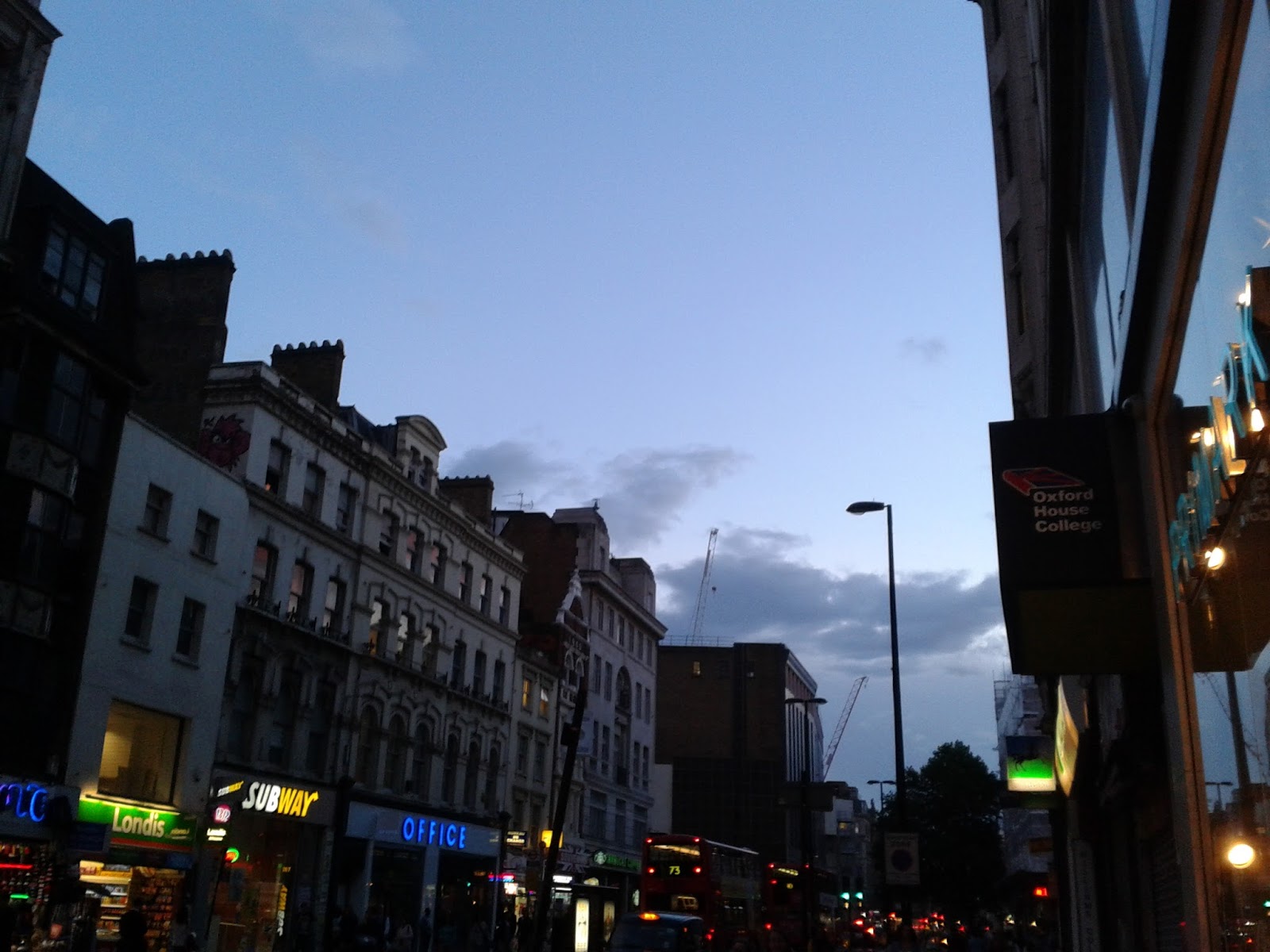
Oxford Street- a view from Primark after a heavy rain shower..

Near River thames, a beach artist making his "tribute to love"

The lane that leads to New College, Oxford


Some scenes of HP that were shot at NC


Oxfordshire Market, August 2013


This is the place that is right below waterloo bridge. every day this man would come and blow bubbles for kids to play with! Another thing I loved was how struggling artists (dancers, musicians, singers, magicians) would come here and sing, dance, play tricks and a crowd would gather. 


Here are a few pictures from the Surreal art section of TATE modern act gallery ..

Work by Dali -

Quintessential London :)